
The Farmer Who Said "No" to John Deere's Settlement
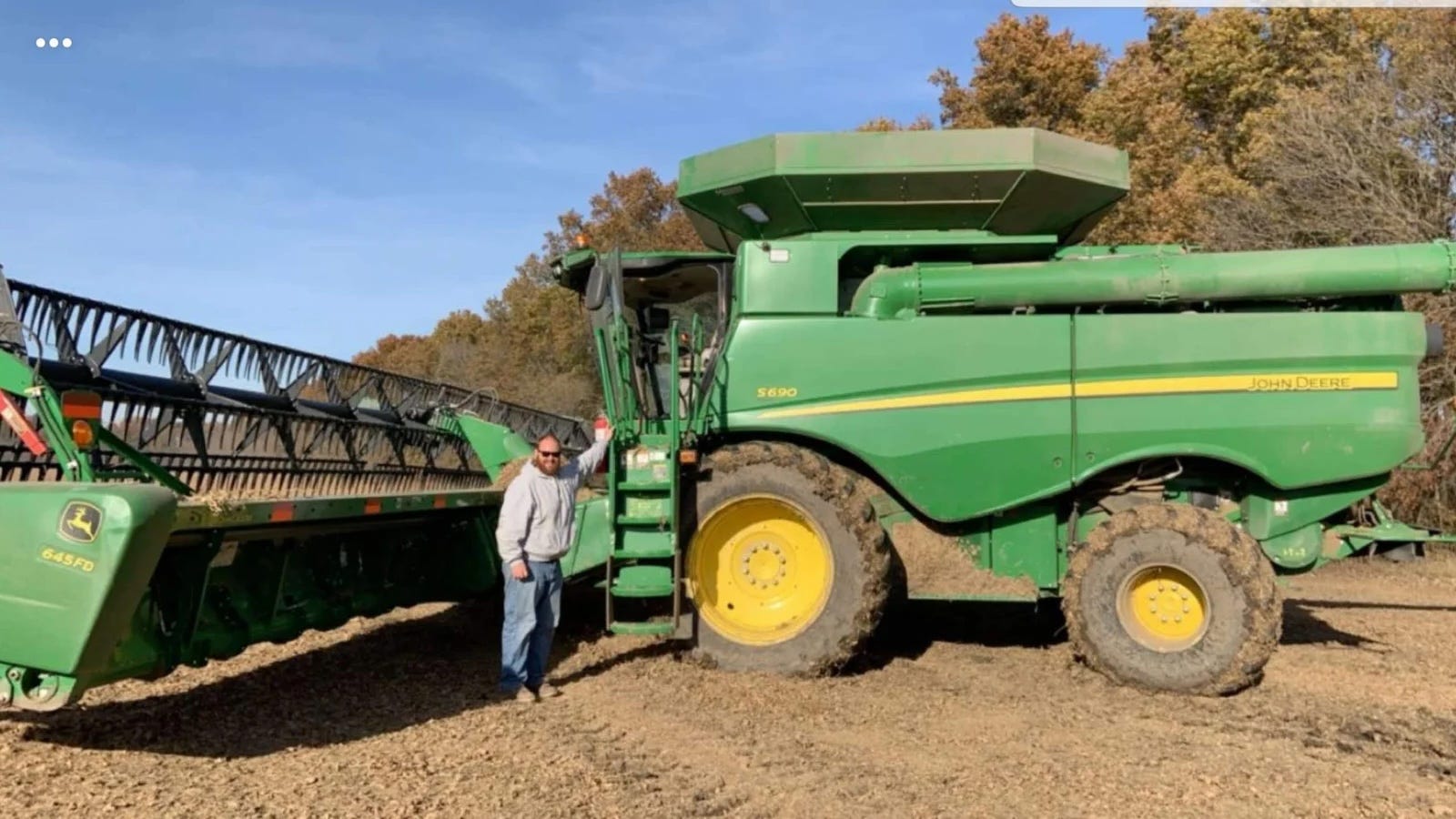
In a legal filing, farmer Jared Wilson argues a proposed legal settlement of a class action lawsuit fails to dismantle John Deere’s repair monopoly and short changes farmers.

For years, farmers have argued that John Deere has built a repair monopoly by locking down the software, tools, and diagnostics needed to fix the equipment they already own. Now, one of the very farmers who helped bring that fight to court in an anti-trust lawsuit says a proposed settlement doesn’t solve that problem—it protects it.
Wilson Farms Land and Cattle Co., a named plaintiff in the federal antitrust lawsuit against John Deere, filed a sweeping objection in the U.S. District Court for the Norther District of Illinois on June 29th asking the court to reject the proposed settlement.
In the filing, Jared Wilson, the owner of Wilson Farms, argues that the proposed settlement asks farmers to give up some of their strongest legal claims against Deere in exchange for modest checks and repair reforms that, in practice, change very little.
Pennies for farmers, millions for lawyers
While the total amount of the settlement is $99 million, Wilson Farms and other critics note that this amount is a tiny fraction of the costs farmers have paid to support Deere’s repair monopoly in the last decade. Deere reported net income of over $5 billion in 2025. The $99 million settlement represents between 4% and 14% of the overcharge damages attached to repair labor that was estimated to be recoverable in the suit.
Doing the math, that means a class action settlement that actually addressed the estimated costs for farmers would range from $700 million to $2.5 billion in payments by Deere to U.S. farmers harmed by its anticompetitive practices.
And $99 million isn’t even the number farmers stand to benefit from. According to the objection, after attorneys’ fees (more than $40 million) and administrative costs, farmers could receive between $48 million and $79 million in actual compensation.
Given the more than 200,000 U.S. farmers covered by the class action and the methodology used to calculate payouts, it means the average recovery is estimated at $0.51 to $0.84 per acre. With an average farm of approximately 470 acres, that translates to $240 to $395 per claimant, the objection argues.

“A check for that amount would likely fail to cover the cost of a single authorized dealer service call made necessary by Deere’s monopolization of the repair services market,” Wilson wrote.
Agricultural repair advocates seconded that. Willie Cade of Graceful Solutions and a board member at Repair.org, the Repair Association, is the grandson of a Deere board member He has been compiling data on the actual costs to farmers of Deere’s repair monopoly. Cade cited the typical example of a 1,200-acre row-crop operation that paid its John Deere dealer $613,346 over the 8-year period covered by the class action suit. That comes to about $511 per acre.
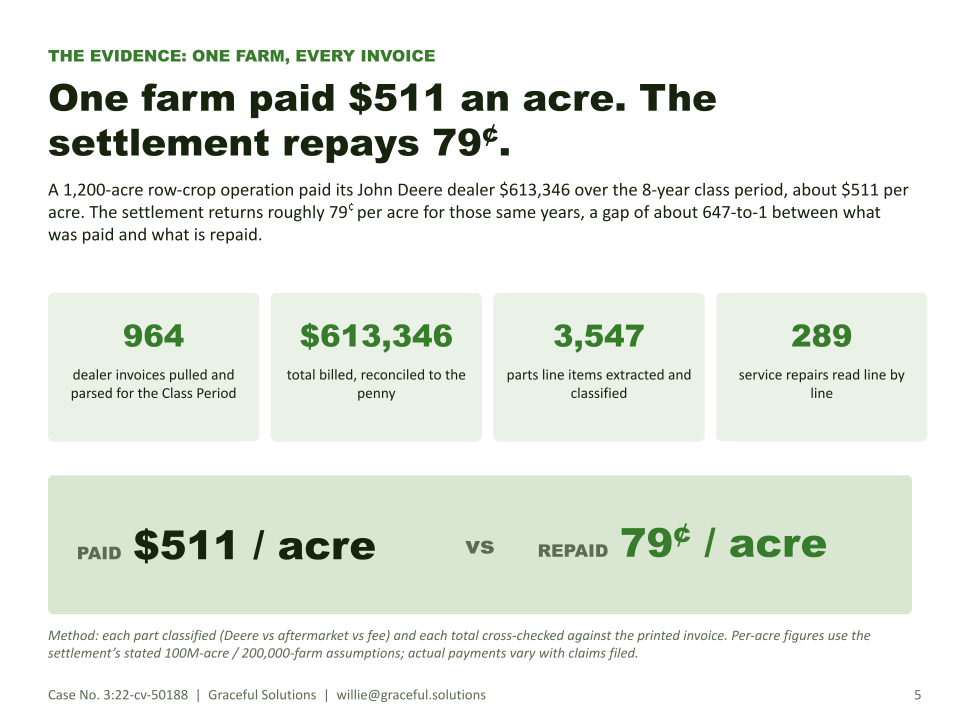
The settlement returns roughly 79¢ per acre to that farmer for those same years, a gap of about 647-to-1 between what was paid and what is repaid, Cade wrote.
With lawyers reaping tens of millions in legal payments while the farmers injured by Deere’s monopolization of the repair services market walk away with just a few hundred dollars, Wilson Farms argues that imbalance should make the court pause before approving the deal.
“The actual settlement agreement is probably going to cost less for John Deere than what litigating this at trial would cost,” Wilson told Fight to Repair in an interview last week.
The objection filed by Wilson Farms also raises questions about the actions of the law firm representing the farmers (aka “Class Counsel”), Minnesota-based Gustafson Gluek, which he claims bent to Deere’s preferences at the expense of farmers in order see their efforts compensated.
Gustafson Gluek did not respond to multiple requests by Fight to Repair for comment on
Signing off on Deere’s repair monopoly
The heart of Wilson Farms’ objection is that the settlement leaves Deere’s restrictive and anti-competitive repair ecosystem largely intact. Under the terms of the settlement, farmers still wouldn’t receive guaranteed access to the software, diagnostic tools, and repair capabilities they’ve been fighting for. Instead, the proposed injunction contains broad carve-outs, weak enforcement provisions, and enough discretion that Deere could continue deciding who gets access to critical repair resources—and who doesn’t.
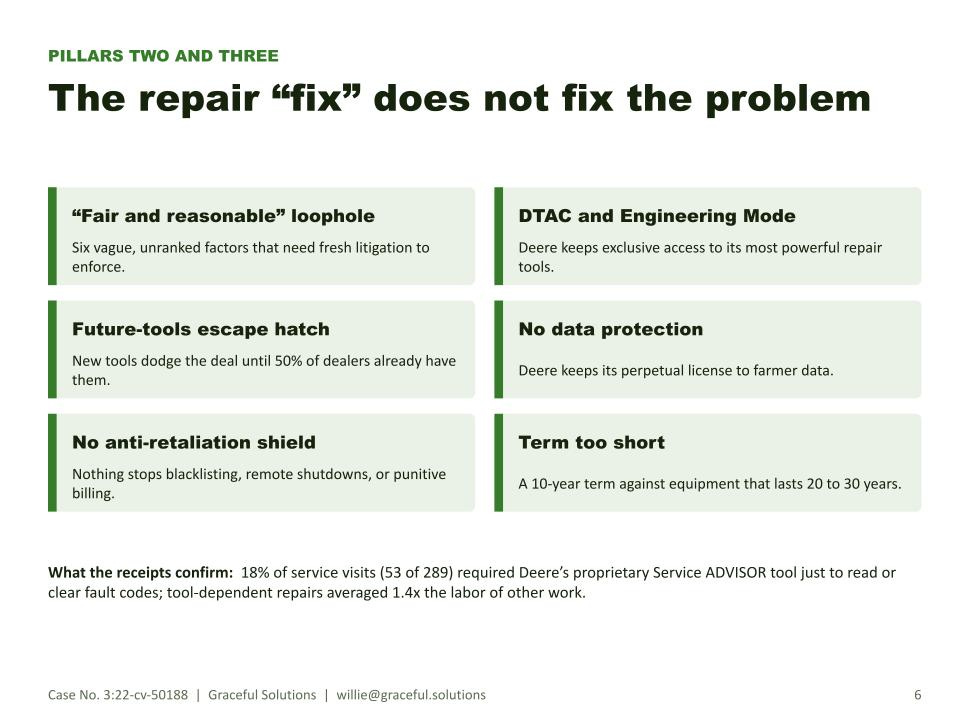
Even worse, Wilson Farms argues, under the terms of the agreement, Deere can continue using many of the same tactics that allegedly created the monopoly in the first place: limiting parts availability, increasing repair costs, delaying service, imposing new fees, or otherwise making independent repair more difficult.
If that’s true, then the settlement doesn’t dismantle the repair monopoly. It simply manages it.
Deere exempted from future class actions over repair restrictions
The Wilson Farms objection also points out something that should concern every equipment owner—not just farmers: Many of the real-world harms caused by repair restrictions aren’t fully compensated at all. Delayed harvests? Crop losses? Equipment downtime? Higher parts prices? Expensive software licenses? Lost productivity? These are the things that keep farmers awake at night, yet Wilson Farms argues those damages receive little or no meaningful compensation under the proposed agreement.

In fact, if the settlement is approved, Deere will receive broad legal protection from future class-action litigation over many of the repair restrictions at the center of this case. Farmers, meanwhile, would remain dependent on Deere’s repair ecosystem while giving up one of their most powerful tools for forcing broader reform: the ability to collectively challenge those restrictions in court.
That’s a big concession by farmers.
“ If we allow this to be the standard, it’s not going to break this monopoly. It’s going to enhance it, and it’s gonna provide (Deere) a lot of cover at the state houses when we’re debating right to repair legislation,” Wilson told Fight to Repair News. “They’re gonna argue that this has been solved and…you shouldn’t step into this.”
Wilson: Class Counsel shut me out
Wilson said he first learned of a potential settlement negotiations via an email on October 3, 2025, when Class Counsel sought his input on a list of injunctive terms they planned to use as their initial position in settlement negotiations.
In the objection, Wilson said he responded with detailed concerns about the terms of the settlement, explaining that they would provide little relief to the Class. After that, “Class Counsel became adversarial toward Mr. Wilson,” the objection claims.
Copies of a long series of emails between Wilson and Gustafson Gluek (Exhibit C) between October, 2025 and April, 2026 show Wilson explaining to the Class Counsel how the injunctive terms of the settlement would not serve the needs of farmers in the class action suit.
In the emails, Wilson repeatedly argues that any settlement must produce true parity for owners and independent repair professionals with John Deere dealerships and authorized repair providers. However, as written, the settlement merely expands access to Deere-controlled tools, allowing the company to continue controlling the repair apparatus needed to service equipment after settlement.
An effective settlement would ensure that repair tools do not remain under Deere’s control and that dealership-level functionality is available to farmers and independent repair professionals.
Wilson also repeatedly asks for the firm to allow him to meet and discuss the agreement with the other farmers listed as class representatives before allowing the settlement to go forward. However, no such meeting ever took place, Wilson said.
“If you review our correspondence, it clearly shows you have been stonewalling me from speaking with them-preventing us from doing our job for the class,” Wilson wrote in an email dated April 9, 2026.
In their responses to him, Gustafson Gluek attorneys Dennis Stewart and Daniel Hedlund explain that antitrust law limits what relief is realistically obtainable while the proposed settlement represents the best practical outcome considering the litigation risk.
The final version of the settlement shared with Wilson Farms in early March, 2026, “reflected the very same deficiencies Mr. Wilson had warned Class Counsel about.” And, on April 1, the Class Counsel notified Mr. Wilson that they would imminently file a motion seeking preliminary approval of the Settlement Agreement and removed Wilson Farms as a Class Representative for the purposes of the Settlement Agreement via a footnote in its preliminary-approval brief.
Focus turns to judge in deciding what’s right
Under federal law (Rule 23), courts must approve class action lawsuit settlements Settlement: The court must approve any settlement, dismissal, or compromise of a class action suit to ensure it is fair, reasonable, and adequate for all class members.
Wilson Farms filing asks the court to reject final approval, closely scrutinize the broad release of claims, consider additional concerns about the adequacy of class representation, and allow Wilson Farms to fully participate in the fairness hearing before any final decision is made.
Whether the court ultimately agrees remains to be seen. A Fairness Hearing scheduled for October 29, 2026, in Rockford, Illinois, will take up the proposed settlement and the objections. There is an opt-out deadline for farmers of September 14th.
Stay tuned for more coverage of the Deere antitrust suit.